| // Copyright 2022 the Vello Authors |
| // SPDX-License-Identifier: Apache-2.0 OR MIT |
| |
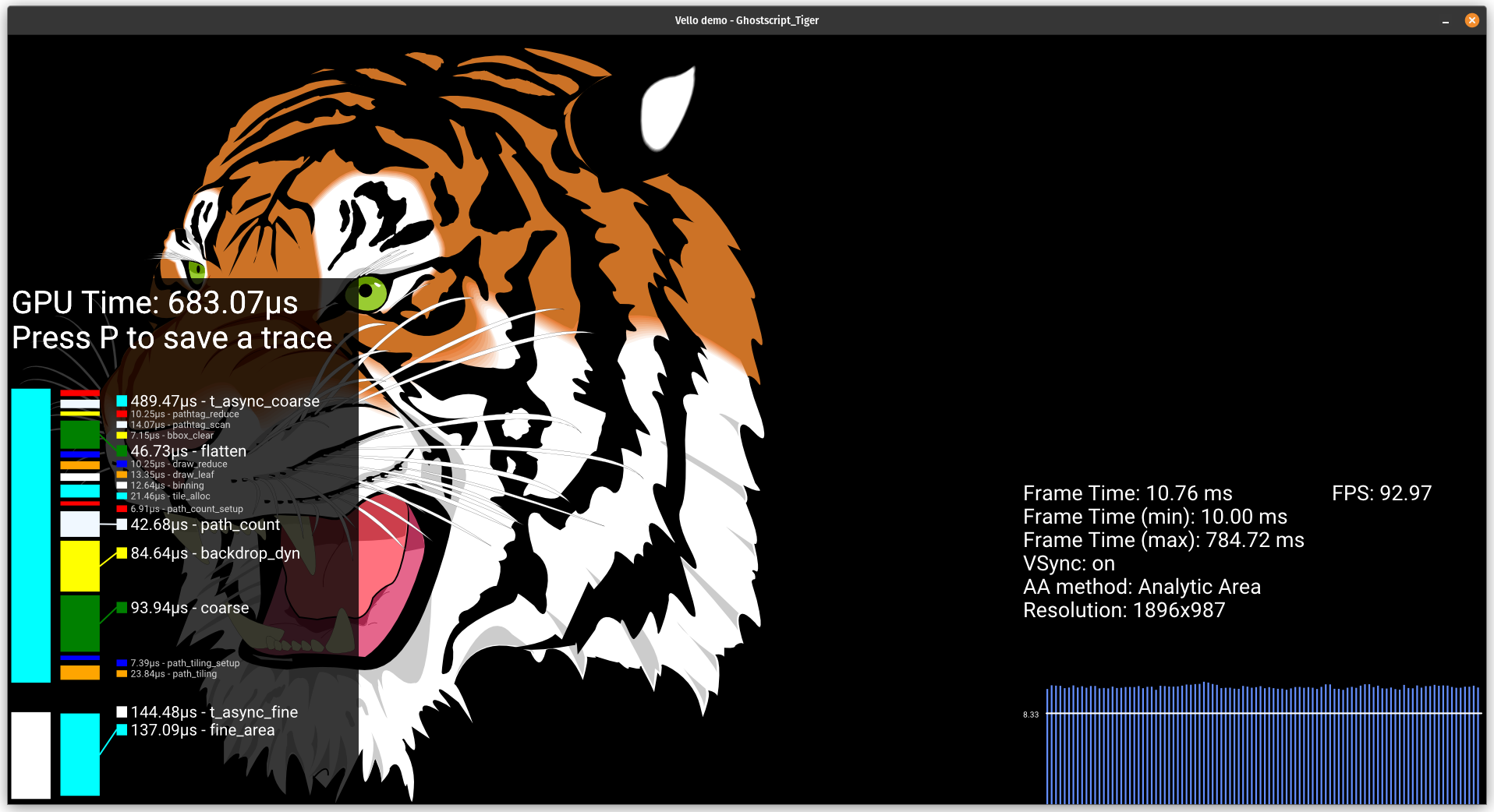
| //! Vello is a 2d graphics rendering engine written in Rust, using [`wgpu`]. |
| //! It efficiently draws large 2d scenes with interactive or near-interactive performance. |
| //! |
| //!  |
| //! |
| //! |
| //! ## Motivation |
| //! |
| //! Vello is meant to fill the same place in the graphics stack as other vector graphics renderers like [Skia](https://skia.org/), [Cairo](https://www.cairographics.org/), and its predecessor project [Piet](https://www.cairographics.org/). |
| //! On a basic level, that means it provides tools to render shapes, images, gradients, texts, etc, using a PostScript-inspired API, the same that powers SVG files and [the browser `<canvas>` element](https://developer.mozilla.org/en-US/docs/Web/API/CanvasRenderingContext2D). |
| //! |
| //! Vello's selling point is that it gets better performance than other renderers by better leveraging the GPU. |
| //! In traditional PostScript-style renderers, some steps of the render process like sorting and clipping either need to be handled in the CPU or done through the use of intermediary textures. |
| //! Vello avoids this by using prefix-scan algorithms to parallelize work that usually needs to happen in sequence, so that work can be offloaded to the GPU with minimal use of temporary buffers. |
| //! |
| //! This means that Vello needs a GPU with support for compute shaders to run. |
| //! |
| //! |
| //! ## Getting started |
| //! |
| //! Vello is meant to be integrated deep in UI render stacks. |
| //! While drawing in a Vello [`Scene`] is easy, actually rendering that scene to a surface setting up a wgpu context, which is a non-trivial task. |
| //! |
| //! To use Vello as the renderer for your PDF reader / GUI toolkit / etc, your code will have to look roughly like this: |
| //! |
| //! ```ignore |
| //! // Initialize wgpu and get handles |
| //! let (width, height) = ...; |
| //! let device: wgpu::Device = ...; |
| //! let queue: wgpu::Queue = ...; |
| //! let mut renderer = Renderer::new( |
| //! &device, |
| //! RendererOptions { |
| //! use_cpu: false, |
| //! antialiasing_support: vello::AaSupport::all(), |
| //! num_init_threads: NonZeroUsize::new(1), |
| //! }, |
| //! ).expect("Failed to create renderer"); |
| //! |
| //! // Create scene and draw stuff in it |
| //! let mut scene = vello::Scene::new(); |
| //! scene.fill( |
| //! vello::peniko::Fill::NonZero, |
| //! vello::Affine::IDENTITY, |
| //! vello::Color::from_rgb8(242, 140, 168), |
| //! None, |
| //! &vello::Circle::new((420.0, 200.0), 120.0), |
| //! ); |
| //! |
| //! // Draw more stuff |
| //! scene.push_layer(...); |
| //! scene.fill(...); |
| //! scene.stroke(...); |
| //! scene.pop_layer(...); |
| //! |
| //! let texture = device.create_texture(&...); |
| //! // Render to a wgpu Texture |
| //! renderer |
| //! .render_to_texture( |
| //! &device, |
| //! &queue, |
| //! &scene, |
| //! &texture, |
| //! &vello::RenderParams { |
| //! base_color: palette::css::BLACK, // Background color |
| //! width, |
| //! height, |
| //! antialiasing_method: AaConfig::Msaa16, |
| //! }, |
| //! ) |
| //! .expect("Failed to render to a texture"); |
| //! // Do things with surface texture, such as blitting it to the Surface using |
| //! // wgpu::util::TextureBlitter. |
| //! ``` |
| //! |
| //! See the [`examples/`](https://github.com/linebender/vello/tree/main/examples) folder to see how that code integrates with frameworks like winit. |
| |
| // LINEBENDER LINT SET - lib.rs - v2 |
| // See https://linebender.org/wiki/canonical-lints/ |
| // These lints aren't included in Cargo.toml because they |
| // shouldn't apply to examples and tests |
| #![warn(unused_crate_dependencies)] |
| #![warn(clippy::print_stdout, clippy::print_stderr)] |
| // Targeting e.g. 32-bit means structs containing usize can give false positives for 64-bit. |
| #![cfg_attr(target_pointer_width = "64", warn(clippy::trivially_copy_pass_by_ref))] |
| // END LINEBENDER LINT SET |
| #![cfg_attr(docsrs, feature(doc_cfg))] |
| // The following lints are part of the Linebender standard set, |
| // but resolving them has been deferred for now. |
| // Feel free to send a PR that solves one or more of these. |
| // Need to allow instead of expect until Rust 1.83 https://github.com/rust-lang/rust/pull/130025 |
| #![allow(missing_docs, reason = "We have many as-yet undocumented items.")] |
| #![expect( |
| missing_debug_implementations, |
| clippy::cast_possible_truncation, |
| clippy::missing_assert_message, |
| reason = "Deferred" |
| )] |
| #![allow( |
| clippy::todo, |
| unreachable_pub, |
| unnameable_types, |
| reason = "Deferred, only apply in some feature sets so not expect" |
| )] |
| |
| mod debug; |
| mod recording; |
| mod render; |
| mod scene; |
| mod shaders; |
| |
| #[cfg(feature = "wgpu")] |
| pub mod util; |
| #[cfg(feature = "wgpu")] |
| mod wgpu_engine; |
| |
| pub mod low_level { |
| //! Utilities which can be used to create an alternative Vello renderer to [`Renderer`][crate::Renderer]. |
| //! |
| //! These APIs have not been carefully designed, and might not be powerful enough for this use case. |
| |
| pub use crate::debug::DebugLayers; |
| pub use crate::recording::{ |
| BindType, BufferProxy, Command, ImageFormat, ImageProxy, Recording, ResourceId, |
| ResourceProxy, ShaderId, |
| }; |
| pub use crate::render::Render; |
| pub use crate::shaders::FullShaders; |
| /// Temporary export, used in `with_winit` for stats |
| pub use vello_encoding::BumpAllocators; |
| } |
| /// Styling and composition primitives. |
| pub use peniko; |
| /// 2D geometry, with a focus on curves. |
| pub use peniko::kurbo; |
| |
| #[cfg(feature = "wgpu")] |
| use peniko::ImageData; |
| #[cfg(feature = "wgpu")] |
| pub use wgpu; |
| |
| pub use scene::{DrawGlyphs, Scene}; |
| pub use vello_encoding::{Glyph, NormalizedCoord}; |
| |
| use low_level::ShaderId; |
| #[cfg(feature = "wgpu")] |
| use low_level::{BumpAllocators, FullShaders, Recording, Render}; |
| use thiserror::Error; |
| |
| #[cfg(feature = "wgpu")] |
| use debug::DebugLayers; |
| #[cfg(feature = "wgpu")] |
| use vello_encoding::Resolver; |
| #[cfg(feature = "wgpu")] |
| use wgpu_engine::{ExternalResource, WgpuEngine}; |
| |
| #[cfg(feature = "wgpu")] |
| use std::{num::NonZeroUsize, sync::atomic::AtomicBool}; |
| #[cfg(feature = "wgpu")] |
| use wgpu::{Device, Queue, TextureView}; |
| #[cfg(all(feature = "wgpu", feature = "wgpu-profiler"))] |
| use wgpu_profiler::{GpuProfiler, GpuProfilerSettings}; |
| |
| /// Represents the anti-aliasing method to use during a render pass. |
| /// |
| /// Can be configured for a render operation by setting [`RenderParams::antialiasing_method`]. |
| /// Each value of this can only be used if the corresponding field on [`AaSupport`] was used. |
| /// |
| /// This can be converted into an `AaSupport` using [`Iterator::collect`], |
| /// as `AaSupport` implements `FromIterator`. |
| #[derive(Debug, Copy, Clone, PartialEq, Eq)] |
| pub enum AaConfig { |
| /// Area anti-aliasing, where the alpha value for a pixel is computed from integrating |
| /// the winding number over its square area. |
| /// |
| /// This technique produces very accurate values when the shape has winding number of 0 or 1 |
| /// everywhere, but can result in conflation artifacts otherwise. |
| /// It generally has better performance than the multi-sampling methods. |
| /// |
| /// Can only be used if [enabled][AaSupport::area] for the `Renderer`. |
| Area, |
| /// 8x Multisampling |
| /// |
| /// Can only be used if [enabled][AaSupport::msaa8] for the `Renderer`. |
| Msaa8, |
| /// 16x Multisampling |
| /// |
| /// Can only be used if [enabled][AaSupport::msaa16] for the `Renderer`. |
| Msaa16, |
| } |
| |
| /// Represents the set of anti-aliasing configurations to enable during pipeline creation. |
| /// |
| /// This is configured at `Renderer` creation time ([`Renderer::new`]) by setting |
| /// [`RendererOptions::antialiasing_support`]. |
| /// |
| /// This can be created from a set of `AaConfig` using [`Iterator::collect`], |
| /// as `AaSupport` implements `FromIterator`. |
| #[derive(Debug, Copy, Clone, PartialEq, Eq)] |
| pub struct AaSupport { |
| /// Support [`AaConfig::Area`]. |
| pub area: bool, |
| /// Support [`AaConfig::Msaa8`]. |
| pub msaa8: bool, |
| /// Support [`AaConfig::Msaa16`]. |
| pub msaa16: bool, |
| } |
| |
| impl AaSupport { |
| /// Support every anti-aliasing method. |
| /// |
| /// This might increase startup time, as more shader variations must be compiled. |
| pub fn all() -> Self { |
| Self { |
| area: true, |
| msaa8: true, |
| msaa16: true, |
| } |
| } |
| |
| /// Support only [`AaConfig::Area`]. |
| /// |
| /// This should be the default choice for most users. |
| pub fn area_only() -> Self { |
| Self { |
| area: true, |
| msaa8: false, |
| msaa16: false, |
| } |
| } |
| } |
| |
| impl FromIterator<AaConfig> for AaSupport { |
| fn from_iter<T: IntoIterator<Item = AaConfig>>(iter: T) -> Self { |
| let mut result = Self { |
| area: false, |
| msaa8: false, |
| msaa16: false, |
| }; |
| for config in iter { |
| match config { |
| AaConfig::Area => result.area = true, |
| AaConfig::Msaa8 => result.msaa8 = true, |
| AaConfig::Msaa16 => result.msaa16 = true, |
| } |
| } |
| result |
| } |
| } |
| |
| /// Errors that can occur in Vello. |
| #[derive(Error, Debug)] |
| #[non_exhaustive] |
| pub enum Error { |
| /// There is no available device with the features required by Vello. |
| #[cfg(feature = "wgpu")] |
| #[error("Couldn't find suitable device")] |
| NoCompatibleDevice, |
| /// Failed to create surface. |
| /// See [`wgpu::CreateSurfaceError`] for more information. |
| #[cfg(feature = "wgpu")] |
| #[error("Couldn't create wgpu surface")] |
| WgpuCreateSurfaceError(#[from] wgpu::CreateSurfaceError), |
| /// Surface doesn't support the required texture formats. |
| /// Make sure that you have a surface which provides one of |
| /// [`TextureFormat::Rgba8Unorm`][wgpu::TextureFormat::Rgba8Unorm] |
| /// or [`TextureFormat::Bgra8Unorm`][wgpu::TextureFormat::Bgra8Unorm] as texture formats. |
| // TODO: Why does this restriction exist? |
| #[cfg(feature = "wgpu")] |
| #[error("Couldn't find `Rgba8Unorm` or `Bgra8Unorm` texture formats for surface")] |
| UnsupportedSurfaceFormat, |
| |
| /// Used a buffer inside a recording while it was not available. |
| /// Check if you have created it and not freed before its last usage. |
| #[cfg(feature = "wgpu")] |
| #[error("Buffer '{0}' is not available but used for {1}")] |
| UnavailableBufferUsed(&'static str, &'static str), |
| /// Failed to async map a buffer. |
| /// See [`wgpu::BufferAsyncError`] for more information. |
| #[cfg(feature = "wgpu")] |
| #[error("Failed to async map a buffer")] |
| BufferAsyncError(#[from] wgpu::BufferAsyncError), |
| /// Failed to download an internal buffer for debug visualization. |
| #[cfg(feature = "wgpu")] |
| #[cfg(feature = "debug_layers")] |
| #[error("Failed to download internal buffer '{0}' for visualization")] |
| DownloadError(&'static str), |
| |
| #[cfg(feature = "wgpu")] |
| #[error("wgpu Error from scope")] |
| WgpuErrorFromScope(#[from] wgpu::Error), |
| |
| /// Failed to create [`GpuProfiler`]. |
| /// See [`wgpu_profiler::CreationError`] for more information. |
| #[cfg(feature = "wgpu-profiler")] |
| #[error("Couldn't create wgpu profiler")] |
| #[doc(hidden)] // End-users of Vello should not have `wgpu-profiler` enabled. |
| ProfilerCreationError(#[from] wgpu_profiler::CreationError), |
| |
| /// Failed to compile the shaders. |
| #[cfg(feature = "hot_reload")] |
| #[error("Failed to compile shaders:\n{0}")] |
| #[doc(hidden)] // End-users of Vello should not have `hot_reload` enabled. |
| ShaderCompilation(#[from] vello_shaders::compile::ErrorVec), |
| } |
| |
| #[cfg_attr( |
| not(feature = "wgpu"), |
| expect(dead_code, reason = "this can be unused when wgpu feature is not used") |
| )] |
| pub(crate) type Result<T, E = Error> = std::result::Result<T, E>; |
| |
| /// Renders a scene into a texture or surface. |
| /// |
| /// Currently, each renderer only supports a single surface format, if it |
| /// supports drawing to surfaces at all. |
| /// This is an assumption which is known to be limiting, and is planned to change. |
| #[cfg(feature = "wgpu")] |
| pub struct Renderer { |
| #[cfg_attr( |
| not(feature = "hot_reload"), |
| expect( |
| dead_code, |
| reason = "Options are only used to reinitialise on a hot reload" |
| ) |
| )] |
| options: RendererOptions, |
| engine: WgpuEngine, |
| resolver: Resolver, |
| image_atlas: Option<recording::ImageProxy>, |
| shaders: FullShaders, |
| #[cfg(feature = "debug_layers")] |
| debug: debug::DebugRenderer, |
| #[cfg(feature = "wgpu-profiler")] |
| #[doc(hidden)] // End-users of Vello should not have `wgpu-profiler` enabled. |
| /// The profiler used with events for this renderer. This is *not* treated as public API. |
| pub profiler: GpuProfiler, |
| #[cfg(feature = "wgpu-profiler")] |
| #[doc(hidden)] // End-users of Vello should not have `wgpu-profiler` enabled. |
| /// The results from profiling. This is *not* treated as public API. |
| pub profile_result: Option<Vec<wgpu_profiler::GpuTimerQueryResult>>, |
| } |
| // This is not `Send` (or `Sync`) on WebAssembly as the |
| // underlying wgpu types are not. This can be enabled with the |
| // `fragile-send-sync-non-atomic-wasm` feature in wgpu. |
| // See https://github.com/gfx-rs/wgpu/discussions/4127 for |
| // further discussion of this topic. |
| #[cfg(all(feature = "wgpu", not(target_arch = "wasm32")))] |
| static_assertions::assert_impl_all!(Renderer: Send); |
| |
| /// Parameters used in a single render that are configurable by the client. |
| /// |
| /// These are used in [`Renderer::render_to_texture`]. |
| pub struct RenderParams { |
| /// The background color applied to the target. This value is only applicable to the full |
| /// pipeline. |
| pub base_color: peniko::Color, |
| |
| /// Dimensions of the rasterization target |
| pub width: u32, |
| pub height: u32, |
| |
| /// The anti-aliasing algorithm. The selected algorithm must have been initialized while |
| /// constructing the `Renderer`. |
| pub antialiasing_method: AaConfig, |
| } |
| |
| #[cfg(feature = "wgpu")] |
| /// Options which are set at renderer creation time, used in [`Renderer::new`]. |
| pub struct RendererOptions { |
| /// If true, run all stages up to fine rasterization on the CPU. |
| /// |
| /// This is not a recommended configuration as it is expected to have poor performance, |
| /// but it can be useful for debugging. |
| // TODO: Consider evolving this so that the CPU stages can be configured dynamically via |
| // `RenderParams`. |
| pub use_cpu: bool, |
| |
| /// Represents the enabled set of AA configurations. This will be used to determine which |
| /// pipeline permutations should be compiled at startup. |
| /// |
| /// By default this will be all modes, to support the widest range of. |
| /// It is recommended that most users configure this. |
| pub antialiasing_support: AaSupport, |
| |
| /// How many threads to use for initialisation of shaders. |
| /// |
| /// Use `Some(1)` to use a single thread. This is recommended when on macOS |
| /// (see <https://github.com/bevyengine/bevy/pull/10812#discussion_r1496138004>) |
| /// |
| /// Set to `None` to use a heuristic which will use many but not all threads |
| /// |
| /// Has no effect on WebAssembly |
| /// |
| /// Will default to `None` on most platforms, `Some(1)` on macOS. |
| pub num_init_threads: Option<NonZeroUsize>, |
| |
| /// The pipeline cache to use when creating the shaders. |
| /// |
| /// For much more discussion of expected usage patterns, see the documentation on that type. |
| pub pipeline_cache: Option<wgpu::PipelineCache>, |
| } |
| |
| #[cfg(feature = "wgpu")] |
| impl Default for RendererOptions { |
| fn default() -> Self { |
| Self { |
| use_cpu: false, |
| antialiasing_support: AaSupport::all(), |
| #[cfg(target_os = "macos")] |
| num_init_threads: NonZeroUsize::new(1), |
| #[cfg(not(target_os = "macos"))] |
| num_init_threads: None, |
| pipeline_cache: None, |
| } |
| } |
| } |
| |
| #[cfg(feature = "wgpu")] |
| struct RenderResult { |
| bump: Option<BumpAllocators>, |
| #[cfg(feature = "debug_layers")] |
| captured: Option<render::CapturedBuffers>, |
| } |
| |
| #[cfg(feature = "wgpu")] |
| impl Renderer { |
| /// Creates a new renderer for the specified device. |
| pub fn new(device: &Device, options: RendererOptions) -> Result<Self> { |
| let mut engine = WgpuEngine::new(options.use_cpu, options.pipeline_cache.clone()); |
| // If we are running in parallel (i.e. the number of threads is not 1) |
| if options.num_init_threads != NonZeroUsize::new(1) { |
| #[cfg(not(target_arch = "wasm32"))] |
| engine.use_parallel_initialisation(); |
| } |
| let shaders = shaders::full_shaders(device, &mut engine, &options)?; |
| #[cfg(not(target_arch = "wasm32"))] |
| engine.build_shaders_if_needed(device, options.num_init_threads); |
| #[cfg(feature = "debug_layers")] |
| let debug = debug::DebugRenderer::new(device, wgpu::TextureFormat::Rgba8Unorm, &mut engine); |
| |
| Ok(Self { |
| options, |
| engine, |
| resolver: Resolver::new(), |
| image_atlas: None, |
| shaders, |
| #[cfg(feature = "debug_layers")] |
| debug, |
| #[cfg(feature = "wgpu-profiler")] |
| profiler: GpuProfiler::new(device, GpuProfilerSettings::default())?, |
| #[cfg(feature = "wgpu-profiler")] |
| profile_result: None, |
| }) |
| } |
| |
| /// Renders a scene to the target texture. |
| /// |
| /// The texture is assumed to be of the specified dimensions and have been created with |
| /// the [`wgpu::TextureFormat::Rgba8Unorm`] format and the [`wgpu::TextureUsages::STORAGE_BINDING`] |
| /// flag set. |
| /// |
| /// If you want to render Vello content to a surface (such as in a UI toolkit), you have two options: |
| /// 1) Render to an intermediate texture, which is the same size as the surface. |
| /// You would then use [`TextureBlitter`][wgpu::util::TextureBlitter] to blit the rendered result from |
| /// that texture to the surface. |
| /// This pattern is supported by the [`util`] module. |
| /// 2) Call `render_to_texture` directly on the [`SurfaceTexture`][wgpu::SurfaceTexture]'s texture, if |
| /// it has the right usages. This should generally be avoided, as some GPUs assume that you will not |
| /// be rendering to the surface using a compute pipeline, and optimise accordingly. |
| pub fn render_to_texture( |
| &mut self, |
| device: &Device, |
| queue: &Queue, |
| scene: &Scene, |
| texture: &TextureView, |
| params: &RenderParams, |
| ) -> Result<()> { |
| let (recording, target) = render::render_full( |
| scene, |
| &mut self.resolver, |
| &self.shaders, |
| &mut self.image_atlas, |
| params, |
| ); |
| let external_resources = [ExternalResource::Image( |
| *target.as_image().unwrap(), |
| texture, |
| )]; |
| self.engine.run_recording( |
| device, |
| queue, |
| &recording, |
| &external_resources, |
| "render_to_texture", |
| #[cfg(feature = "wgpu-profiler")] |
| &mut self.profiler, |
| )?; |
| // N.B. This is horrible; this integration of wgpu-profiler really needs some work... |
| #[cfg(feature = "wgpu-profiler")] |
| { |
| self.profiler.end_frame().unwrap(); |
| if let Some(result) = self |
| .profiler |
| .process_finished_frame(queue.get_timestamp_period()) |
| { |
| self.profile_result = Some(result); |
| } |
| } |
| |
| Ok(()) |
| } |
| |
| /// Overwrite `image` with `texture`. |
| /// |
| /// Most users should prefer [`register_texture`](Self::register_texture), which |
| /// ergonomically encapulates these requirements. |
| /// |
| /// `texture` must have the [`wgpu::TextureFormat::Rgba8Unorm`] format and |
| /// the [`wgpu::TextureUsages::COPY_SRC`] flag set. The `Rgba8UnormSrgb` format |
| /// might also be supported, but this is not tested. |
| /// |
| /// The given `Texture`'s data will be copied into the slot in Vello's image |
| /// atlas where the image would be placed each frame. |
| /// This has the effect that wherever you request the image to be drawn (e.g. |
| /// through [`Scene::draw_image`]), the data from the texture will be used instead. |
| /// |
| /// Correct behaviour is not guaranteed if the texture does not have the same |
| /// dimensions as the image, nor if an image which uses the same [blob] but different |
| /// dimensions would be rendered. |
| /// |
| /// [blob]: peniko::ImageData::data |
| pub fn override_image( |
| &mut self, |
| image: &ImageData, |
| texture: Option<wgpu::TexelCopyTextureInfoBase<wgpu::Texture>>, |
| ) -> Option<wgpu::TexelCopyTextureInfoBase<wgpu::Texture>> { |
| match texture { |
| Some(texture) => self.engine.image_overrides.insert(image.data.id(), texture), |
| None => self.engine.image_overrides.remove(&image.data.id()), |
| } |
| } |
| |
| /// Marks `image` as dirty in the atlas cache, so its override texture will be re-copied on |
| /// the next render. |
| /// |
| /// Call this each frame for any `image` whose override texture has changed since the last |
| /// render. Otherwise, it's possible stale image data from the atlas will be used. |
| pub fn mark_override_image_dirty(&mut self, image: &ImageData) { |
| self.resolver.mark_image_dirty(image); |
| } |
| |
| /// Register a [`wgpu::Texture`] with Vello, to allow drawing GPU-resident data. |
| /// |
| /// The returned `Image` can be used in [`Scene`]s (only those rendered with this `Renderer`) |
| /// Rendering Scenes which use this `Image` with other `Renderer`s will panic. |
| /// |
| /// `texture` must have the [`wgpu::TextureFormat::Rgba8Unorm`] format and |
| /// the [`wgpu::TextureUsages::COPY_SRC`] flag set. This is because the data will |
| /// be copied into Vello's image atlas at the start of each frame. |
| /// The `Rgba8UnormSrgb` format might also be supported, but this is not tested. |
| /// The texture is assumed to have unpremultiplied alpha. |
| /// |
| /// This is a utility wrapper around [`override_image`](Self::override_image). |
| /// For greater control, use that method. |
| /// |
| /// If the texture is no longer active then it should be unregistered using [`unregister_texture`](Self::unregister_texture) |
| pub fn register_texture(&mut self, texture: wgpu::Texture) -> ImageData { |
| // Create a fake, empty blob which will be used to back the returned image |
| // This image data will never be read by Vello, due to being added to |
| // image_overrides, below. |
| let fake_blob = peniko::Blob::new(std::sync::Arc::new(&[])); |
| |
| let image = ImageData { |
| data: fake_blob, |
| format: peniko::ImageFormat::Rgba8, |
| alpha_type: peniko::ImageAlphaType::Alpha, |
| width: texture.width(), |
| height: texture.height(), |
| }; |
| |
| // For this utility API, we take the full texture and use the base layer and mip level |
| let texture_base = wgpu::TexelCopyTextureInfoBase { |
| texture, |
| mip_level: 0, |
| origin: wgpu::Origin3d::ZERO, |
| aspect: wgpu::TextureAspect::All, |
| }; |
| |
| // We overwrite any attempt to use the fake blob, instead reading from the texture |
| self.engine |
| .image_overrides |
| .insert(image.data.id(), texture_base); |
| |
| image |
| } |
| |
| /// Unregister a [`wgpu::Texture`] that was registered with [`register_texture`](Self::register_texture). |
| pub fn unregister_texture(&mut self, handle: ImageData) { |
| self.engine.image_overrides.remove(&handle.data.id()); |
| } |
| |
| /// Reload the shaders. This should only be used during `vello` development |
| #[cfg(feature = "hot_reload")] |
| #[doc(hidden)] // End-users of Vello should not have `hot_reload` enabled. |
| pub async fn reload_shaders(&mut self, device: &Device) -> Result<(), Error> { |
| let scope = device.push_error_scope(wgpu::ErrorFilter::Validation); |
| let mut engine = WgpuEngine::new(self.options.use_cpu, self.options.pipeline_cache.clone()); |
| // We choose not to initialise these shaders in parallel, to ensure the error scope works correctly |
| let shaders = shaders::full_shaders(device, &mut engine, &self.options)?; |
| #[cfg(feature = "debug_layers")] |
| let debug = debug::DebugRenderer::new(device, wgpu::TextureFormat::Rgba8Unorm, &mut engine); |
| let error = scope.pop().await; |
| if let Some(error) = error { |
| return Err(error.into()); |
| } |
| self.engine = engine; |
| self.image_atlas = None; |
| self.shaders = shaders; |
| #[cfg(feature = "debug_layers")] |
| { |
| self.debug = debug; |
| } |
| Ok(()) |
| } |
| |
| /// Renders a scene to the target texture using an async pipeline. |
| /// |
| /// Almost all consumers should prefer [`Self::render_to_texture`]. |
| /// |
| /// The return value is the value of the `BumpAllocators` in this rendering, which is currently used |
| /// for debug output. |
| /// |
| /// This return type is not stable, and will likely be changed when a more principled way to access |
| /// relevant statistics is implemented |
| #[cfg_attr(docsrs, doc(hidden))] |
| #[deprecated( |
| note = "render_to_texture should be preferred, as the _async version has no stability guarantees" |
| )] |
| pub async fn render_to_texture_async( |
| &mut self, |
| device: &Device, |
| queue: &Queue, |
| scene: &Scene, |
| texture: &TextureView, |
| params: &RenderParams, |
| debug_layers: DebugLayers, |
| ) -> Result<Option<BumpAllocators>> { |
| if cfg!(not(feature = "debug_layers")) && !debug_layers.is_empty() { |
| static HAS_WARNED: AtomicBool = AtomicBool::new(false); |
| if !HAS_WARNED.swap(true, std::sync::atomic::Ordering::Release) { |
| log::warn!( |
| "Requested debug layers {debug_layers:?} but `debug_layers` feature is not enabled" |
| ); |
| } |
| } |
| |
| let result = self |
| .render_to_texture_async_internal(device, queue, scene, texture, params) |
| .await?; |
| |
| #[cfg(feature = "debug_layers")] |
| { |
| let mut recording = Recording::default(); |
| let target_proxy = recording::ImageProxy::new( |
| params.width, |
| params.height, |
| recording::ImageFormat::Rgba8, |
| ); |
| if let Some(captured) = result.captured { |
| let bump = result.bump.as_ref().unwrap(); |
| // TODO: We could avoid this download if `DebugLayers::VALIDATION` is unset. |
| let downloads = DebugDownloads::map(&self.engine, &captured, bump).await?; |
| self.debug.render( |
| &mut recording, |
| target_proxy, |
| &captured, |
| bump, |
| params, |
| &downloads, |
| debug_layers, |
| ); |
| |
| // TODO: this sucks. better to release everything in a helper |
| // TODO: it would be much better to have a way to safely destroy a buffer. |
| self.engine.free_download(captured.lines); |
| captured.release_buffers(&mut recording); |
| } |
| let external_resources = [ExternalResource::Image(target_proxy, texture)]; |
| self.engine.run_recording( |
| device, |
| queue, |
| &recording, |
| &external_resources, |
| "render_to_texture_async debug layers", |
| #[cfg(feature = "wgpu-profiler")] |
| &mut self.profiler, |
| )?; |
| } |
| |
| #[cfg(feature = "wgpu-profiler")] |
| { |
| self.profiler.end_frame().unwrap(); |
| if let Some(result) = self |
| .profiler |
| .process_finished_frame(queue.get_timestamp_period()) |
| { |
| self.profile_result = Some(result); |
| } |
| } |
| |
| Ok(result.bump) |
| } |
| |
| async fn render_to_texture_async_internal( |
| &mut self, |
| device: &Device, |
| queue: &Queue, |
| scene: &Scene, |
| texture: &TextureView, |
| params: &RenderParams, |
| ) -> Result<RenderResult> { |
| let mut render = Render::new(); |
| let encoding = scene.encoding(); |
| // TODO: turn this on; the download feature interacts with CPU dispatch. |
| // Currently this is always enabled when the `debug_layers` setting is enabled as the bump |
| // counts are used for debug visualiation. |
| let robust = cfg!(feature = "debug_layers"); |
| let recording = render.render_encoding_coarse( |
| encoding, |
| &mut self.resolver, |
| &self.shaders, |
| &mut self.image_atlas, |
| params, |
| robust, |
| ); |
| let target = render.out_image(); |
| let bump_buf = render.bump_buf(); |
| #[cfg(feature = "debug_layers")] |
| let captured = render.take_captured_buffers(); |
| self.engine.run_recording( |
| device, |
| queue, |
| &recording, |
| &[], |
| "t_async_coarse", |
| #[cfg(feature = "wgpu-profiler")] |
| &mut self.profiler, |
| )?; |
| |
| let mut bump: Option<BumpAllocators> = None; |
| if let Some(bump_buf) = self.engine.get_download(bump_buf) { |
| let buf_slice = bump_buf.slice(..); |
| let (sender, receiver) = futures_intrusive::channel::shared::oneshot_channel(); |
| buf_slice.map_async(wgpu::MapMode::Read, move |v| sender.send(v).unwrap()); |
| receiver.receive().await.expect("channel was closed")?; |
| let mapped = buf_slice.get_mapped_range(); |
| bump = Some(bytemuck::pod_read_unaligned(&mapped)); |
| } |
| // TODO: apply logic to determine whether we need to rerun coarse, and also |
| // allocate the blend stack as needed. |
| self.engine.free_download(bump_buf); |
| // Maybe clear to reuse allocation? |
| let mut recording = Recording::default(); |
| render.record_fine(&self.shaders, &mut recording); |
| let external_resources = [ExternalResource::Image(target, texture)]; |
| self.engine.run_recording( |
| device, |
| queue, |
| &recording, |
| &external_resources, |
| "t_async_fine", |
| #[cfg(feature = "wgpu-profiler")] |
| &mut self.profiler, |
| )?; |
| Ok(RenderResult { |
| bump, |
| #[cfg(feature = "debug_layers")] |
| captured, |
| }) |
| } |
| } |
| #[cfg(all(feature = "debug_layers", feature = "wgpu"))] |
| pub(crate) struct DebugDownloads<'a> { |
| pub lines: wgpu::BufferSlice<'a>, |
| } |
| |
| #[cfg(all(feature = "debug_layers", feature = "wgpu"))] |
| impl<'a> DebugDownloads<'a> { |
| pub async fn map( |
| engine: &'a WgpuEngine, |
| captured: &render::CapturedBuffers, |
| bump: &BumpAllocators, |
| ) -> Result<DebugDownloads<'a>> { |
| use vello_encoding::LineSoup; |
| |
| let Some(lines_buf) = engine.get_download(captured.lines) else { |
| return Err(Error::DownloadError("linesoup")); |
| }; |
| |
| let lines = lines_buf.slice(..bump.lines as u64 * size_of::<LineSoup>() as u64); |
| let (sender, receiver) = futures_intrusive::channel::shared::oneshot_channel(); |
| lines.map_async(wgpu::MapMode::Read, move |v| sender.send(v).unwrap()); |
| receiver.receive().await.expect("channel was closed")?; |
| Ok(Self { lines }) |
| } |
| } |
